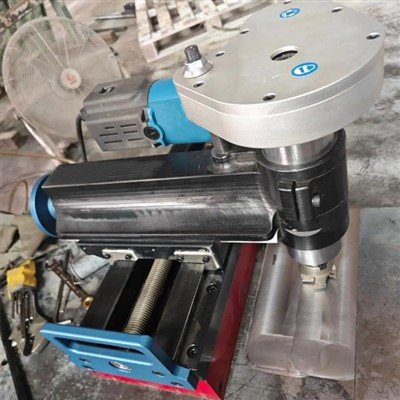
Line Boring Accessories As a bore welder supplier, I get this question all the time from workshops, pipeline crews, and heavy equipment repair teams that have a need to weld large, round components but aren’t sure if their existing bore welder will work for circumferential applications. Let’s break this down clearly, from what each type of welding actually is, how bore welders are built, real-world use cases that prove it works, and the limits you need to know to avoid mistakes. First, let’s get the definitions straight, because that’s where a lot of the confusion starts. Circumferential welding is any weld made around the outer or inner circumference of a cylindrical part—think a pipe joint, a heavy axle shaft, a pressure vessel section, or a large valve body where the weld needs to be continuous, around the entire round surface. Bore welding, by contrast, is a specialized process designed for welding the inside (bore) of large, hollow cylindrical parts, like the inner diameter of a hydraulic cylinder barrel, the inside of a pump housing, or a large engine cylinder liner. On paper, these sound like very different jobs, but the hardware and process flexibility of modern bore welders blur that line more than you’d expect. Let’s start with how a standard bore welder is built, because that’s the foundation of why it can do circumferential welding. A basic bore welder is a portable, precision welding system mounted on a track that you secure to the inner wall of a hollow part. It’s got a carriage that moves along the track, a welding torch that’s aligned radially (meaning it extends straight out from the center of the cylinder bore), and a drive mechanism that lets the carriage rotate 360 degrees around the central axis of the part. That radial alignment is key—when the carriage spins, the torch follows a perfect circular path. Now, if you flip that scenario: if you’re working on an outer cylindrical part, like two pipe sections butted end-to-end, you can invert the setup. Instead of mounting the track to the inner bore, you mount it to the outer circumference of the first pipe, so the torch is positioned radially inward, aimed at the gap between the two pipes. The same 360-degree rotation function that’s used for bore welding becomes exactly what you need for a circumferential weld here. This isn’t some hack I’ve seen teams use on a lark—this is a documented application of bore welder technology for circumferential pipe welding, especially in spaces where a traditional pipe welding rotator or a fixed circumferential welding head can’t fit. Let me give you a concrete example: last year, a team working on a cross-country oil pipeline repair reached out to us. They had a 48-inch diameter pipe run that needed a circumferential weld in a remote, narrow mountain access area where they couldn’t bring in a large pipe rotating fixture. Their normal setup for circumferential welding was stuck back at a depot too big to transport, so they used two of our 52-inch capacity bore welders, mounted on the outer walls of each pipe section, to line up the gap and make the weld. The result was a full-penetration circumferential weld that passed all pressure tests, and the whole setup fit into a single pickup truck for transport. That’s the kind of versatility that makes bore welders worth considering for circumferential jobs, even if they’re marketed primarily for bore work. Now, let’s get into the technical details that make this work, and the limits that are critical to avoid errors. First, the alignment of the torch is non-negotiable. For a circumferential weld to be high-quality, the torch has to stay a consistent distance from the base metal the entire 360 degrees of the weld, and the path has to be perfectly round to ensure uniform heat input and weld penetration. Bore welders are built with precision linear drives and rotary encoders that control the torch position within 0.01 inches, which is far more precise than many dedicated circumferential welding heads for small to medium diameter parts. That precision is a big advantage for circumferential welds, because inconsistent torch distance leads to spatter, uneven penetration, and weld failure. Another technical plus: most modern bore welders support multiple welding processes, including GTAW (TIG), GMAW (MIG), and FCAW. For circumferential welds that require high strength and no porosity—like pressure vessel or pipeline welds—GTAW with filler wire is common, and our bore welders are built with integrated wire feeders that work seamlessly during 360-degree rotation. You don’t have to stop and feed wire manually, which eliminates gaps in the weld that would cause issues. But here’s where the limits come in, because this isn’t a one-size-fits-all solution. First, diameter constraints. Bore welders are sized for a minimum and maximum inner bore diameter, so when you’re adapting one for outer circumferential welding, you have to make sure the mount and track fit the outer diameter of your part. For example, a 12-inch capacity bore welder (meaning it’s designed for parts with a 12-inch minimum inner bore) can’t be used on a 6-inch outer diameter pipe, because the track won’t wrap around that small a surface. Most of our bore welders go up to 120-inch capacity, so for large diameter parts, that’s not an issue, but it’s a key check. Second, joint preparation. Circumferential welds almost always require a beveled joint to ensure full penetration, and when you’re using a bore welder in the inverted outer mount position, you have to make sure the bevel is machined or cut precisely around the entire circumference. Unlike dedicated pipe welding rotators that hold the part fixed while the torch moves, the bore welder setup means the torch is following a fixed path, so any variation in the bevel will lead to inconsistent weld depth. We always recommend that teams do a test weld on a scrap piece of the same material and diameter first, to adjust the torch height and travel speed before doing the actual production weld. Third, wall thickness. Bore welders are designed for parts with a minimum wall thickness that varies by model, and while they can handle circumferential welds on medium wall thickness parts (like Schedule 40 pipe or 1-inch thick pressure vessel sections), very thin wall parts can be tricky. The weight of the track and carriage, even when lightweight, can cause minor distortion on thin wall parts during rotation, so you may need to add temporary clamps or supports to hold the part aligned. Now, let’s address a common counterpoint: why would someone use a bore welder for circumferential work instead of a dedicated circumferential welding system? The answer is portability and access, which are huge factors for many industries. Dedicated circumferential welding heads for large parts are often large, heavy, and require specialized fixtures that are hard to transport to remote job sites. A bore welder, by contrast, is modular—our standard bore welders break down into parts that weigh between 30 and 80 pounds each, so two people can carry them into a mine, a pipeline worksite, or a shipyard compartment that’s too small for big welding equipment. I’ve seen this come up a lot in the heavy equipment repair industry: when you need to re-weld the circumferential weld on a large excavator bucket or a mining haul truck’s axle housing, you can’t easily move the 50,000-pound part to a welding bay. A bore welder setup lets you work on-site, positioning the track around the outer circumference of the part and making the weld without moving the entire machine. That’s a game-changer for downtime, which is critical in industries where a single piece of equipment being out of service can cost thousands of dollars a day. But wait, there are some applications where a bore welder isn’t the right fit for circumferential welding, and it’s important to call those out so you don’t waste time or money. If you’re working on small diameter parts (under 10 inches) that have a regular circumferential joint, a dedicated portable circumferential welding head is usually more cost-effective, because it’s designed specifically for that job and smaller diameters require very precise, compact alignment that a bore welder’s track setup might overcomplicate. Also, for high-volume production of circumferential welds, a dedicated system with automated rotation and integrated fit-up tools will be faster than adapting a bore welder, since bore welders are designed more for single or low-volume custom jobs than mass production. Another thing to consider: material compatibility. Bore welders work with most common welding metals, including carbon steel, stainless steel, aluminum, and alloy steels, which is the same range needed for most circumferential weld applications. That said, for highly reactive materials like titanium, you’ll need to ensure your bore welder has integrated shielding gas systems, which most modern models do, so that’s not a barrier. From my experience as a bore welder supplier, the most successful applications of this adaptation come from teams that plan ahead. Last year, I worked with a ship repair yard that needed to re-weld the circumferential seams on 3 large ballast tanks for a cargo ship. The ship was in dry dock, and the tank compartments were cramped, so they couldn’t fit their normal large circumferential welding rotator. They used four of our 48-inch bore welders, mounted on the outer circumference of each tank section, and finished the welds in half the time it would have taken to bring in the alternative equipment, because they didn’t have to spend 2 days positioning and aligning the big rotator. The welds were inspected and approved by the marine surveyor on the first try. That’s the kind of result that proves a bore welder can absolutely be used for circumferential welding—when you use it for the right application, plan the setup properly, and account for its design limits. Let’s also clear up a myth: some people think that because bore welders are built for inner work, the outer circumferential weld will have weaker penetration or quality. That’s not the case when the setup is done correctly. The key is matching the torch’s travel speed, amperage, and voltage to the material thickness, just like you would for any circumferential weld. The precision of the bore welder’s rotary drive actually helps here, because the speed is consistent around the entire 360 degrees, so you don’t get the slowdown or speedup that can happen with manual welding or even some dedicated rotating systems that have alignment issues. So, to circle back to the original question: Can a bore welder be used for circumferential welding? The short answer is yes, but with important caveats about size, access, and application. It’s not a replacement for a dedicated circumferential welding system in every scenario, but it’s a powerful, portable alternative when you’re working in remote locations, on large parts that can’t be moved, or in spaces where standard welding equipment won’t fit. If you’re considering this for your next project, the first step is to match the size of your bore welder to the diameter of your part, calculate the wall thickness to ensure the track and carriage won’t cause distortion, and do a test weld on scrap material to adjust parameters before doing the actual production weld. As a bore welder supplier, we work with teams every day to assess their specific projects and figure out if adapting a bore welder for circumferential work makes sense, or if a different system would be a better fit. If you’re working on a project that has tight access, large diameter parts, or remote site constraints and you want to learn more about how a bore welder can support your circumferential welding needs, reach out to our team to discuss your requirements and find the right solution for your workflow. References: 1. Welding Handbook, Volume 4: Welding Processes, 9th Edition. American Welding Society. 2. Portable Bore Welding: Versatility for Industrial Repair and Fabrication. Industrial Welding Equipment Association, 2021. 3. Circumferential Welding of Heavy-Duty Components: Best Practices for Field Repair. Journal of Manufacturing Processes, Vol. 45, 2020. 4. Field Welding Techniques for Pipeline and Pressure Vessel Repairs. Pipeline Industries Guild, 2022. Bore Welder

Shangqiu JDA Machinery Technology Co., Ltd.
With abundant experience, we are one of the most professional bore welder manufacturers and suppliers in China. We warmly welcome you to buy cheap bore welder for sale here from our factory. Quality products and reasonable price are available.
Address: No. 55 Pingyuan Middle Road, Liangyuan District, Shangqiu, Henan, China
E-mail: sales@jdamachines.com
WebSite: https://www.jdamachines.com/
