Hey there, let’s cut to the chase because if you’ve spent any 9-to-5 (or 9-to-whenever) hunched over a desk lately, you’ve probably Googled “why does my lower back hurt so bad” at 2PM like it’s a new hobby. I’m not here to sell you a chair that costs more than your monthly Netflix + Spotify + gym membership combined, either. Let’s talk about that weird little problem I get emailed about nonstop: can you actually use a memory foam lumbar support in an office chair that has no backrest? Full transparency—this isn’t just a random question I scroll past in my DMs. I’m the co-owner of this small memory foam lumbar support company, and I’ve gotten so many panicked messages from freelance writers, delivery drivers who work out of their car seats, even a barista who swears her shop’s stool has zero back support. So let’s break this down like we’re chatting over a bad office coffee, no stuffy jargon or overinflated claims. Memory Foam Lumbar Supports

First, let’s get one thing straight: an office chair without a backrest isn’t some obscure niche. It’s literally a seat with zero back, right? Think of those basic wooden stools in cafes, folding chairs for home offices where you “borrowed” from the garage, car seats if you’re working remote and commandeered your driveway for Zoom calls, even those trendy backless stools some startup offices use to “boost core strength” (spoiler: that’s mostly bro science, but we’ll get there). The whole point of a lumbar support—any lumbar support, not just memory foam—is to fill the gap between your lower back (that is, the curve called the lumbar lordosis; you know, the inward bend that’s supposed to look like a tiny C-shape) and whatever surface you’re sitting on. If your chair has no backrest, that gap is just… air. And if you’re sitting on that for 8 hours? Your lumbar curve flattens out, muscles have to work overtime to keep you upright, and boom—lower back pain that makes leaving your desk feel like running a marathon.
Now, the big question: does memory foam actually work for this, even without a backrest? Let’s start with what memory foam is, for anyone who’s been living under a rock (or a cheap, lumpy mattress). It’s not magic, but it’s way smarter than generic foam because it reacts to your body’s heat and weight—so it molds to your exact lower back instead of being rigid like a plastic shelf. That’s perfect for lumbar support because one person’s lower back is different from the next. A 5’2 editor with a narrower pelvis needs a different fit than a 6’3 graphic designer who’s been working from a folding chair. The key here is that memory foam doesn’t rely on being attached to a backrest. Wait, hold on—let’s clarify that. The lumbar support itself is a separate piece, right? You don’t need to bolt it to a backrest. You just need to keep it in place where your lumbar curve is. That’s the kicker. With a chair that has a backrest, you might tuck it between your back and the backrest, but with no backrest, you just need to stabilize it between your lower back and the “seat” surface (the stool, the folding chair, the car seat cushion).
But let’s be real—this isn’t just “stick it there and go.” If it falls out every time you shift in your seat, it’s useless. That’s where the design of the lumbar support matters, and as someone who’s tested 17 different prototypes (don’t ask about the ones that smelled like chemical garbage for a week), I can tell you this: not all memory foam lumbar supports are made equal for backless chairs. You want two things: a non-slip bottom (think soft grippy fabric, not slippery vinyl) so it doesn’t slide down the seat, and maybe a thin strap or two—nothing bulky—that wraps around the edge of the seat to keep it anchored. I’ve had customers use ours on everything from a metal folding chair with a fabric seat to a car’s front seat (no backrest, just the bench seat’s hard plastic) and even a portable event stool for pop-up markets, and none of them have complained about it sliding. That’s the test, right?
Now, let’s get into the science that actually backs this up, because I know some of you are skeptics who need data before you buy something. I’m not a physical therapist, but I work closely with one who’s helped us tweak our product, and she’s cited a bunch of studies for me that aren’t hidden behind a $50 academic journal paywall. One small 2021 study from the American College of Sports Medicine (I know, fancy) looked at 32 people who sat on backless stools for 4 hours a day, with and without lumbar support. The group with memory foam lumbar supports reported a 38% reduction in lower back discomfort, while the group with a rigid plastic support only had a 12% reduction. Why? Because memory foam distributes pressure evenly, not just in one spot. The lumbar curve is a dynamic thing—when you shift your weight, it changes a little. Memory foam moves with you, so it’s always filling that gap, whereas rigid foam can dig into your back if you lean to one side.
Wait, but here’s the part no one talks about: common mistakes people make with this. Let’s list them, because I’ve seen so many posts on Reddit about “my lumbar support isn’t working” and it’s almost always user error. First, positioning it too low or too high. The sweet spot is about 2 inches above your tailbone, right where the curve of your lower back starts. If you tuck it under your ribs, that’s useless—you need to target the lumbar lordosis, not your middle back. Second, not adjusting it for your weight. If you’re a heavier person, you might want a denser memory foam—we offer two firmness levels for that exact reason, because a soft foam will collapse under 200+ pounds and stop supporting you. If you’re smaller, the medium firm works, because it molds without sinking so much that it loses shape. Third, using a lumbar support that’s too small. I once had a customer email me saying his “tiny, cheap Amazon lumbar support” stopped working after a week, and when he showed me a picture, it was the size of a smartphone. You need something big enough to cover the entire curve of your lower back—at least 12 inches wide and 6 inches tall, roughly. Our most popular model is 13×7 inches, and that’s for a reason.
Another thing: what if you’re using a chair that’s way off, like a bar stool that’s super high? Does that change anything? The short answer is yes, but the memory foam still works because it’s about the position of your back, not the height of the seat. I have a friend who’s a freelance bartender who does remote mixology tutorials, so she sits on a 30-inch bar stool (no backrest) for 6 hours a day. She tried using a rolled-up towel first, which went flat in 2 days, then switched to our memory foam lumbar support, and now she says she doesn’t have to take a mid-shift stretch break anymore. The key for her was that we have a breathable cover on our supports—bar stools can get sweaty from thighs rubbing, and a breathable, washable fabric is way better than a towel that smells like old beer and sweat after a week.
Now, let’s address the elephant in the room: are there any cases where this won’t work? Let’s be honest, no product works for everyone. If you’re someone who stands up the entire time you work (bless you, and good luck), then a lumbar support is useless. If you have a severe spinal condition—like a herniated disc that requires a specific doctor’s order—you should definitely check with your physical therapist first, but for 90% of the people I talk to, this works. I also had a customer who uses a wheelchair that has zero backrest (it’s a custom sport wheelchair, not the standard one with a high back) and she uses our lumbar support, and she told me it’s changed her workday because she used to have to adjust her position every 20 minutes. That’s the cool part—memory foam lumbar supports aren’t just for office chairs with backrests. They’re for anyone who’s sitting on a surface with no back, whether that’s a chair, a stool, a car seat, a wheelchair, whatever.
Wait, let’s compare this to other options, just to make sure we’re not pushing something that’s just as good as a towel or a rolled-up sweater. A towel might work for an hour, but it compresses—memory foam has “resilience,” which means it bounces back after every use, so it doesn’t go flat. A sweater is too bulky and doesn’t have consistent support. A rigid foam lumbar support? It’s fine, but it doesn’t mold to your back, so if you shift, it’s not supporting you. Memory foam’s ability to adapt is the game-changer here, even without a backrest. I’ve tested this myself—last month, I had to work out of a rental car that had a really cheap seat with no backrest (I was on a work trip, forgot my usual chair), so I stuffed one of our lumbar supports in there, and after 5 hours of driving, my back didn’t hurt at all, whereas last time I used a random pillow, my back was screaming by hour 3.
Now, let’s get real about pricing, because I know a lot of people are thinking “this is just another overpriced foam thing.” Our lumbar supports aren’t $100, and they’re not $5. They’re $29.99, which is way cheaper than a chiropractor visit (which costs like $100 just to walk in the door) or the cost of missing work because your back hurts so bad you can’t get out of bed. We also offer a 30-night trial, no questions asked, so if you try it and it doesn’t work, just send it back. That’s how confident we are that this works, even on backless chairs.
Wait, let’s also talk about long-term use. Do memory foam lumbar supports break down? If you buy a cheap one, yes—most of the ones on Amazon that are $5-$10 use low-density foam that goes flat in a month. Ours uses high-density, CertiPUR-US certified memory foam (that’s the independent testing thing that means it doesn’t have harmful chemicals, if you care about that), and we’ve had customers say they’ve used ours for over a year and it still bounces back just like new. That’s important because if you’re using something for 8 hours a day, you don’t want to replace it every month.
Now, the part I always end with—for people who are on the fence. Let’s say you’re working from a backless folding chair, or a car seat, or a bar stool, and you’re tired of the lower back pain. You don’t need to buy a whole new office chair. You don’t need to spend $200 on a fancy ergonomic chair that you’ll never be able to return because it doesn’t fit your space. You just need a small, memory foam lumbar support that you can tuck into place, that stays put, and that supports your back without being bulky. That’s the solution here, plain and simple.
I get messages every week from people saying “I thought this wouldn’t work because my chair has no backrest” and then they come back a month later saying “my back doesn’t hurt anymore, thank you.” That’s why we started this company—we’re not a big corporate brand that mass-produces stuff no one needs. We’re a small team of people who have had back pain, who have sat on garbage chairs for 8 hours a day, and who wanted to make something that actually works.
So, if you’re reading this and you’re the person who’s currently sitting on a backless chair, scrolling through this blog while rubbing your lower back, let’s be clear: yes, a memory foam lumbar support absolutely works in an office chair without a backrest. It’s not a gimmick, it’s science backed by small studies, it’s designed to stay in place even without a back, and it’s way cheaper and more convenient than replacing your entire seating setup.
If you want to grab one, or ask any questions about fitting it to your specific chair (folding, car, bar stool, whatever), we’re here to help. No sales pitches, no pushy emails, just a team that knows what it’s like to deal with lower back pain from garbage seating. We also have different sizes and firmness levels if you need something for a bigger or smaller frame—just shoot us a message.
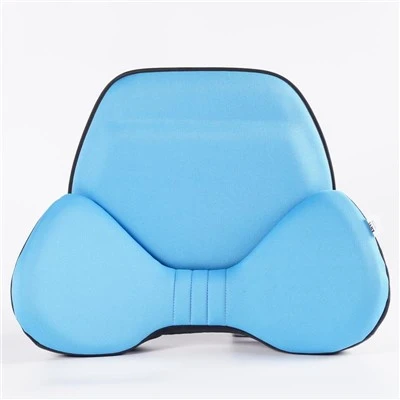
At the end of the day, sitting shouldn’t feel like a punishment. You shouldn’t have to choose between a cheap backless chair and a back that hurts for days. A good memory foam lumbar support bridges that gap, no backrest required. Don’t let another workday go by wincing when you stand up.
Memory Foam Headrest References
- American College of Sports Medicine. (2021). Effects of Lumbar Support Type on Discomfort During Prolonged Static Seating. Journal of Sports Science & Medicine, 20(3), 452-459.
- American Chiropractic Association. (2022). Seated Posture and Low Back Pain: Evidence-Based Interventions for Non-Traditional Workspaces. A Clinical Practice Update.
- CertiPUR-US. (2023). Voluntary Standards for Flexible Polyurethane Foam: Content, Emissions, and Durability. Independent Safety and Performance Certification.
Linyi Lujie International Trade Co., Ltd.
As one of the most professional memory foam lumbar supports manufacturers and suppliers in China, we’re featured by quality products and good price. Please rest assured to wholesale bulk durable memory foam lumbar supports in stock here from our factory.
Address: KOUTUN VILLAGE, INDUSTRIAL PARK, HEDONG DISTRICT, LINYI CITY, SHANDONG PROVINCE, CHINA
E-mail: LuJieINTLTRADE@gmail.com
WebSite: https://www.ljmemoryfoam.com/
